

Crucial channel links the Greater Bay Area, Hainan Free Trade Port and Beibu Gulf city cluster
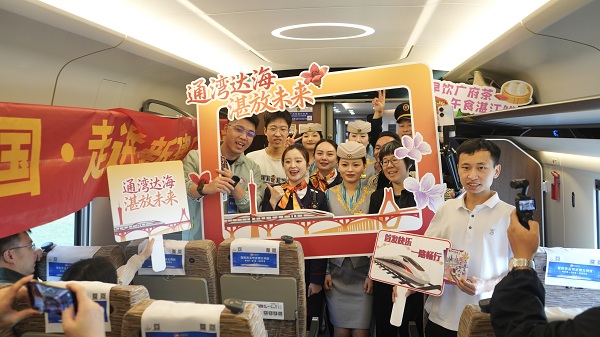
Passengers and train attendants pose for a photo at the first train service of the Guangzhou-Zhanjiang High-Speed Railway on Monday. WU DONGJUN/FOR CHINA DAILY
On Dec 22, the Guangzhou-Zhanjiang High-Speed Railway officially opened. This steel artery compresses the travel time between the two cities to 92 minutes.
Connecting the Guangdong-Hong Kong-Macao Greater Bay Area, and as an important part of the national high-speed railway network's coastal passenger transport corridor, the main line of the high-speed railway is 401 kilometers long, with a design speed of 350 km per hour. Between Guangzhou and Zhanjiang, it connects cities such as Foshan, Zhaoqing and Maoming. It is a crucial channel linking the GBA, the Hainan Free Trade Port and the Beibu Gulf city cluster, experts said. They added that it will accelerate Zhanjiang's development and enhance its land, sea and air transportation network.
Back in July 2018, the Jiangmen-Zhanjiang Railway, with a design speed of 200 km/h, ushered in the "high-speed train era" for western Guangdong.
Zhanjiang is at the southernmost tip of the Chinese mainland, in the southwest of Guangdong and strategically located between Hainan province and the Guangxi Zhuang autonomous region. It is one of the first 14 coastal cities in China that opened to the outside world and is positioned as a hub of the Guangdong modern coastal economic belt and a subcenter city of Guangdong.
At a news conference held by the Zhanjiang government on Wednesday, Huang Weiyan, director of the Zhanjiang development and reform bureau, said that the Guangzhou-Zhanjiang high-speed railway, a "golden corridor", will significantly facilitate the rapid aggregation and efficient allocation of high-end elements such as capital, information and technology in the surrounding areas towards Zhanjiang.
The opening of the railway will support Zhanjiang's industrial transformation from a "manufacturing base" to a full-chain model of "research and development plus manufacturing plus services", establishing it as an important "industrial partner" of the GBA, said Huang, adding that it will enhance industry chain collaboration, expand business opportunities and attract high-end talent.
Additionally, it will promote the outward expansion of Zhanjiang's distinctive and excellent industries, allowing them to reach the huge consumer market of the GBA more conveniently, according to Huang.
For a long time, Zhanjiang has played the role of a key port and an industrial center in the southwestern part of Guangdong, relying on its deepwater harbor. Via the transportation advantages, industrial base and opening-up toward the Association of Southeast Asian Nations, the city has been on the fast track to become Guangdong's subcenter city and a hub of the Guangdong modern coastal economic belt.
Donghai Island is the main location of the Zhanjiang Economic and Technological Development Zone and serves as the economic backbone of Zhanjiang. Yang Jiedong, director of the zone's administrative committee, said he believes that the "cities integration effect" generated by the high-speed rail era will transform Zhanjiang from a traditional "back-end base" to a "front-line position" that can be involved in the industrial division of labor in the GBA.
With the help of the 350 km/h rail, Zhanjiang will undertake advanced producer services, such as industrial design, inspection and testing, and supply chain services, promoting Donghai Island's transformation from a port-related industrial base to a "modern industrial community" with composite functions, Yang said.
Shorter journey may greatly change the psychological distance of talent toward Zhanjiang. Experts said Zhanjiang will more effectively attract high-level professionals to "settle", innovate in flexible models such as "weekend engineers" and "cloud consultants" for bringing in talent, and lower the cost for talent from western Guangdong to return home.
Gao Xiuli, an associate professor from the School of Management at Guangdong Ocean University, said that the opening of the Guangzhou-Zhanjiang high-speed railway coincides with the Hainan FTP's special customs operations on Dec 18, which elevates Zhanjiang from a hub of western Guangdong to a "dual gateway" connecting the GBA and the Hainan FTP.
According to Gao, in transportation, the city will become a core hub thanks to a roughly 90-minutes direct route to Guangzhou and future connectivity to Hainan. In industries, it will promote cross-regional collaboration of "GBA R&D plus Zhanjiang manufacturing" and "Hainan headquarters plus Zhanjiang base". In people's life and cultural tourism, it will accelerate regional integration and enhance talent attractiveness, Gao added.
In the future, a key step is to open the high-speed railway project that connects Zhanjiang and Haikou in Hainan and deepen industrial collaboration to unleash its "inland gateway" value, said Gao.


Copyright © Foreign Affairs Office, People's Government of Guangdong Province. All rights reserved.