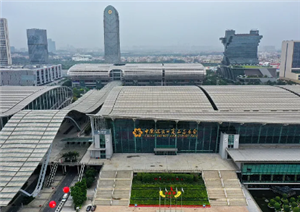


Calls to turn words into action as high-level dialogue on governance closes
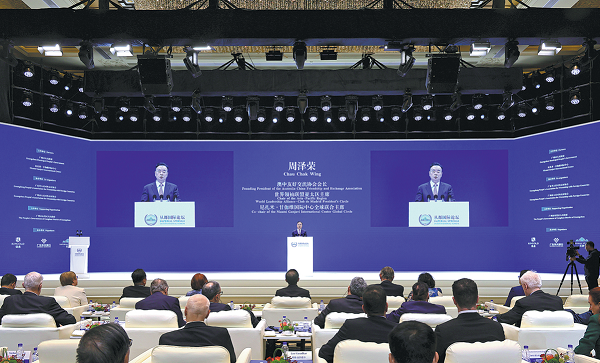
Chau Chak Wing, founding president of the Australia China Friendship and Exchange Association, chair of the World Leadership Alliance-Club de Madrid's Asia-Pacific region and co-chair of the Nizami Ganjavi International Center Global Circle, delivers a speech during the 2025 Imperial Springs International Forum held in Guangzhou, Guangdong province, from Monday to Wednesday. The Imperial Springs International Convention Center in Guangzhou. Guests from home and abroad share insights during the forum. CHINA DAILY
At the closing ceremony of the 2025 Imperial Springs International Forum, or ISIF, on Wednesday, distinguished international figures shared their insights on addressing global turbulence, advancing multilateral cooperation, reshaping global governance, and underscoring the urgent need for collective action amid unprecedented uncertainties.
The three-day event, held in Guangzhou, Guangdong province, attracted over 30 former heads of state, government leaders and heads of international organizations, alongside more than 100 Chinese and international experts, scholars and business leaders.
Vaira Vike-Freiberga, former president of Latvia and co-chair of the Nizami Ganjavi International Center, emphasized the necessity of a truly multilateral system founded on mutual respect and dignity.
She advocated for equitable trade relations over unilateral dominance, warning that brute power devoid of principle "will not help humanity survive as a planet; instead, it will lead to bloodshed, perpetuate global inequities and hinder efforts to address climate change".
Sun Tao, director of the Department of American and Oceanian Affairs at the Chinese People's Association for Friendship with Foreign Countries, said that while the forum had concluded, its spirit of reflection and dialogue should persist, with actions being accelerated.
He expressed hope that attendees would translate the insights, connections and consensus forged at the event into tangible actions and practical cooperation in their respective fields and institutions.
Sun also called on insightful individuals from all nations to collaborate with China in advancing global initiatives related to development, security, civilization and governance, aiming to build a community with a shared future for humanity.
Since its inception in 2014, the Imperial Springs International Forum has become a leading platform for nongovernmental diplomacy in China's new era, dedicated to promoting dialogue, building consensus and advancing exchanges and cooperation.
Over the years, it has welcomed over 200 former international dignitaries and more than 600 representatives from various sectors to China, expanding its global network from Guangzhou to Beijing and beyond, characterized by high-level participation, strong professionalism and extensive international engagement.
This year's forum featured 10 events, including closed-door meetings, plenary discussions, parallel forums, and the Guangzhou Night investment promotion event.
Key topics included "global security challenges in an era of uncertainty", "reforming and improving global governance to enhance stability and certainty", and "artificial intelligence: striking a balance between innovation, security and governance".
During the session on global security challenges, participants acknowledged the complexity and interconnectivity of traditional and nontraditional security threats, affecting all nations.
They advocated for a common, comprehensive, cooperative and sustainable security concept, urging the abandonment of a cold-war mentality and bloc politics, resolving differences through dialogue and consultation, opposing arbitrary sanctions or threats of force, and jointly safeguarding global security and stability.
Speakers stressed that global security governance must address the legitimate security concerns of all countries, build a balanced, effective and sustainable security architecture, and ensure that security dividends benefit people worldwide.
Amid ongoing geopolitical conflicts, sluggish global economic recovery, worsening climate change and growing wealth gaps, human society faces increasing deficits in peace, development, security and governance, said Yang Zhen, vice-chairman of the National Committee of the Chinese People's Political Consultative Conference.
At this historic crossroads, Yang advocated for rejecting the outdated zero-sum game mindset and embracing a new concept of shared destiny, choosing the path of win-win cooperation over division and confrontation.
Regarding global governance reform, guests noted that the current system is no longer adaptable to new circumstances and changes, making reform imperative.
Chau Chak Wing, founding president of the Australia China Friendship and Exchange Association, chair of the World Leadership Alliance-Club de Madrid's Asia-Pacific region and co-chair of the Nizami Ganjavi International Center Global Circle, stated that the world has entered a new period of turbulence and transformation, with resurgent unilateralism, shocks to the international system and pressing global challenges.
The forum's creation and growth respond to the needs of the global situation. "The more differences there are, the more we need dialogue; the more challenges we face, the more we need exchanges," he noted.
Many former dignitaries also pointed out that China's global initiatives on development, security and civilization provide important guidance for global governance reform, helping to consolidate international consensus and promote the evolution of the global governance system toward greater fairness and rationality.
In a parallel forum on AI, experts, scholars and industry representatives from China and abroad discussed the opportunities and challenges brought by AI technological development.
There was broad consensus on the need to strengthen global AI governance, establish and improve international rules and standards, prioritize both technological innovation and safety norms, and promote the healthy development of AI within a legal framework.
On economic and development issues, participants called for increased support for developing countries, addressing financing bottlenecks and aiding the transfer of green technologies.
They opposed trade protectionism and unilateral sanctions, advocating for the safeguarding of the multilateral trading system, promoting the liberalization and facilitation of global trade and investment and jointly driving global economic recovery and growth.
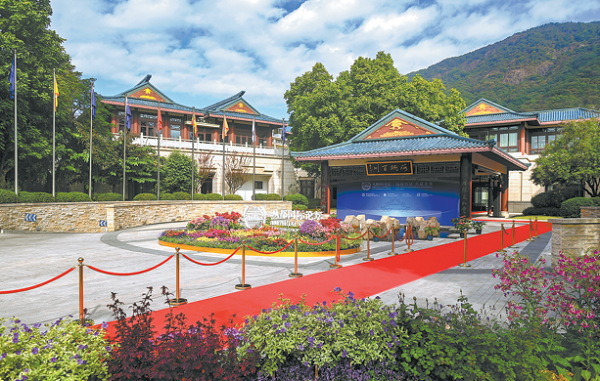
Chau Chak Wing, founding president of the Australia China Friendship and Exchange Association, chair of the World Leadership Alliance-Club de Madrid's Asia-Pacific region and co-chair of the Nizami Ganjavi International Center Global Circle, delivers a speech during the 2025 Imperial Springs International Forum held in Guangzhou, Guangdong province, from Monday to Wednesday. The Imperial Springs International Convention Center in Guangzhou. Guests from home and abroad share insights during the forum. CHINA DAILY
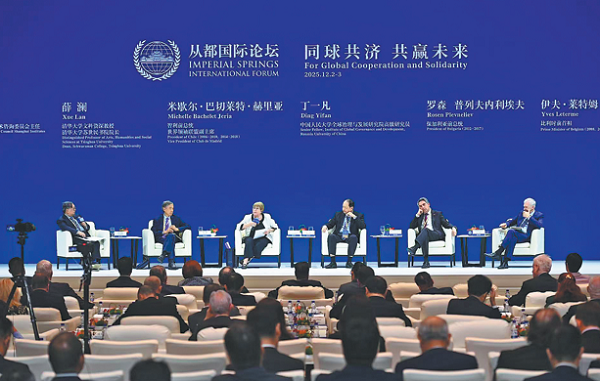
Chau Chak Wing, founding president of the Australia China Friendship and Exchange Association, chair of the World Leadership Alliance-Club de Madrid's Asia-Pacific region and co-chair of the Nizami Ganjavi International Center Global Circle, delivers a speech during the 2025 Imperial Springs International Forum held in Guangzhou, Guangdong province, from Monday to Wednesday. The Imperial Springs International Convention Center in Guangzhou. Guests from home and abroad share insights during the forum. CHINA DAILY


Copyright © Foreign Affairs Office, People's Government of Guangdong Province. All rights reserved.